Paediatric reference ranges load here when you open this panel. See the full table of normal values.
ENT Airway Pack Complete
What this deck covers
ENT Collection 3 – 50 questions across 5 ENT topics, each with the correct answer and an explanation of why the other options are wrong. This collection is written for candidates preparing for the MRCPCH and Saudi and Gulf licensing examinations such as the Arab Board, DHA and OMSB, and it works as a single long drilling set rather than as a short case deck.
The topics in this collection
- Stridor & Laryngomalacia
- Subglottic Stenosis
- Croup
- Epiglottitis
- Inhaled Foreign Body
What this collection teaches
- Stridor & Laryngomalacia. Laryngomalacia gives inspiratory stridor that worsens supine, with feeding, and with agitation — lying flat lets gravity pull the tongue and floppy supraglottic tissues back. It starts in the first ~2 weeks, peaks at 4–8 months, and the babies are classic “happy wheezers”: noisy but feeding, growing, and thriving.
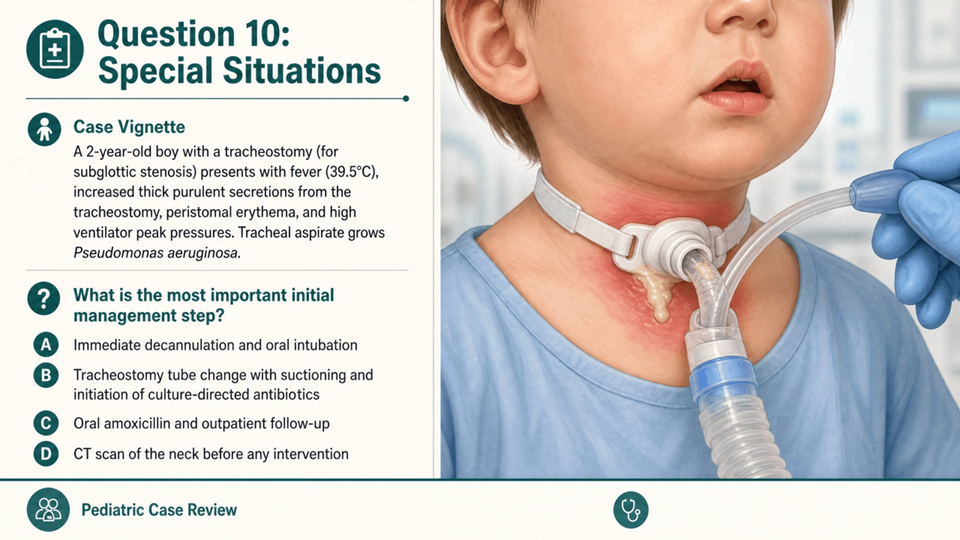
- Subglottic Stenosis. The key clue is recent intubation — ETT pressure on the cricoid mucosa causes ischemic injury and subglottic scarring. Acquired SGS gives biphasic/inspiratory stridor at a fixed extrathoracic site. Afebrile, clear lungs, and no viral prodrome argue against croup; epiglottitis is toxic with drooling/high fever; foreign body is sudden with unilateral findings.
- Croup. Viral croup starts with 12–72 h of URI symptoms, then an abrupt seal-like barking cough and inspiratory stridor that worsen at night. Parainfluenza type 1 causes subglottic inflammation (the “steeple sign”). The child stays non-toxic and swallows secretions — unlike epiglottitis (toxic, drooling) — with a viral prodrome rather than a sudden choking event.
- Epiglottitis. The classic picture — the four Ds: Drooling, Dysphagia, Dysphonia (muffled “hot-potato” voice), and Distressed inspiratory stridor — plus the tripod position, high fever, toxic appearance, rapid onset over hours, and crucially no barking cough. The absent barking cough is what most strongly separates epiglottitis from croup.
- Inhaled Foreign Body. A sudden choking episode while eating (the “penetration syndrome”) occurs in >90% of confirmed aspirations. Beware the deceptive silent interval — symptoms ease as the object settles distally and reflexes fatigue, causing dangerous delays. Current stability does NOT rule out aspiration; a witnessed choke on a high-risk food (peanuts) mandates imaging and a low threshold for bronchoscopy.
Exam pearls from this collection
- Prone positioning pulls the floppy supraglottic tissues forward off the airway, so stridor eases; crying/feeding worsen it (more negative inspiratory pressure sucks the tissue in). A barking cough/hoarseness suggests croup or cord pathology; asymmetric chest rise points to a lower-airway/foreign-body cause. Screen for synchronous airway lesions (~20%).
- Laryngomalacia is a dynamic obstruction — the supraglottic tissues (omega-shaped epiglottis, short aryepiglottic folds, arytenoids) collapse inward during the negative pressure of inspiration, which is exactly why the stridor is purely inspiratory. Likely from delayed cartilage maturation and/or altered laryngeal neuromuscular tone.
All 50 questions in this collection, with the full explanation of every option, are part of Pediatric Case Review membership. See what is included, or start with the free Pediatric Exam Review Sets.
More from this system: all ENT case decks · the free Pediatric Exam Review Sets · pediatric reference values.