Paediatric reference ranges load here when you open this panel. See the full table of normal values.
Case Complete
What this deck covers
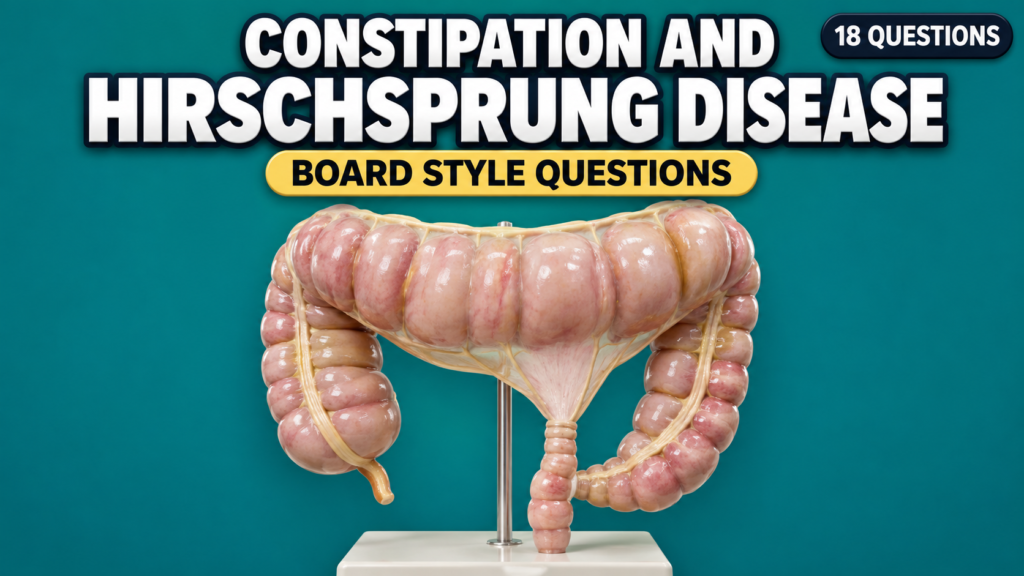
Hirschsprung disease in 18 board-style clinical cases with worked explanations. Each case gives you a clinical vignette, four options, the correct answer, and an explanation of why each of the other three is wrong, with the guideline or textbook it follows named on the answer.
Board-style teaching questions for paediatricians and trainees preparing for paediatric board, MRCPCH and licensing examinations. Written from published guidelines and standard paediatric textbooks, with the source named on every answer.
The 18 cases, in order
- The history that matters
- A gush on examination
- A biopsy taken too low
- The stain that helps
- The enema picture
- Balloon in the rectum
- Small and uniform, no cone
- Mapping the affected bowel
- Not the usual constipation
- The main gene
- Thin stools after surgery
- A white forelock
- Shallow breaths in sleep
- Asking about a sibling
- Siting the stoma
- The definitive operation
- Warning signs at home
- Looking ahead
Diagnoses and management options tested
Across the 18 cases you are asked to choose between options such as: Red-faced straining for minutes before soft stools, Faeces trapped above a segment unable to relax, It confirms long-segment disease above the rectum, Heavy eosinophil infiltration of the mucosa, A rectum narrower than the sigmoid colon, A normal fall in internal sphincter pressure, An ultrashort segment at the anal sphincter, It usually affects the small bowel before the colon, An empty rectum, with no soiling in his pants, The CFTR gene, A permanent end colostomy without trials, Mowat-Wilson syndrome, Congenital central hypoventilation syndrome, A son with short-segment involvement.
Clinical pearls from this deck
- Late meconium in a term baby: think of a rectal biopsy.
- Explosive gush after a rectal exam: a segment stuck shut.
- Biopsy too close to the anus can mislead: go higher.
- Calretinin fibres absent: aganglionosis is supported.
- Rectum narrower than sigmoid: a reversed ratio.
- No sphincter relaxation to distension: biopsy next.
Work through the deck once for recognition, then again a week later to test yourself — each question gives the answer and explains why every other option fails.
More from this system: all Gastroenterology Board Questions case decks · pediatric reference values.