Paediatric reference ranges load here when you open this panel. See the full table of normal values.
Case Complete
What this deck covers
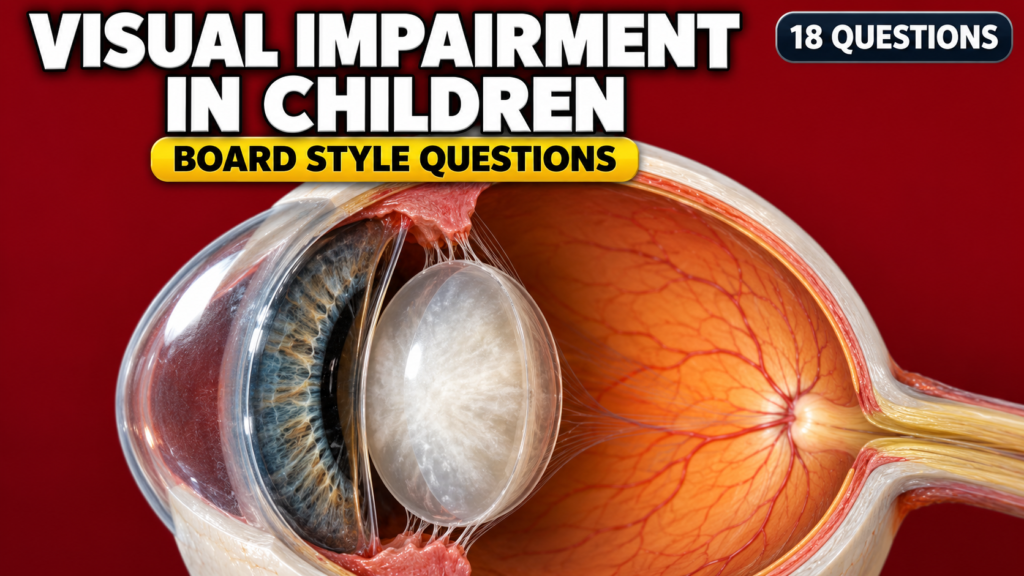
retinoblastoma and leukocoria in 18 board-style clinical cases with worked explanations. Each case gives you a clinical vignette, four options, the correct answer, and an explanation of why each of the other three is wrong, with the guideline or textbook it follows named on the answer.
Board-style teaching questions for paediatricians and trainees preparing for paediatric board, MRCPCH and licensing examinations. Written from published guidelines and standard paediatric textbooks, with the source named on every answer.
The 18 cases, in order
- The white flash
- Why we check at every visit
- A turning eye
- Both sides
- Age at the first sign
- Two events
- A third site
- The new baby
- Not a tumour
- What comes first
- Losing the eye
- A small one at the edge
- Why not radiation
- Leave it alone
- What we can promise
- Too late seen
- Still watching
- The next generation
Diagnoses and management options tested
Across the 18 cases you are asked to choose between options such as: A normal difference between the two eyes, Because a white reflex is often the only early sign, Long sight, which is very common at this age, A change confined to the eye tissue itself, Inherited disease needs only one further change, One copy alone must be damaged for a tumour to form, A late effect of the earlier treatment on the ears, How severe the first child’s disease turned out to be, Toxocara, with a scar dragging the retina, The sight first, whatever else it costs, It prevents the other eye being affected, No treatment at all, with a review in twelve months, A second cancer arising in the treated field, The sample would be too small to be useful.
Clinical pearls from this deck
- A white pupil in a photograph is never normal.
- The reflex check is the only screen we have.
- A new squint needs the back of the eye looked at.
- Disease in both eyes means a change in every cell.
- Inherited disease shows itself in the first year.
- Both copies must go before a tumour can grow.
Work through the deck once for recognition, then again a week later to test yourself — each question gives the answer and explains why every other option fails.
More from this system: all ENT and ophthalmology case decks · pediatric reference values.